Agile Transformation in a Corporate Environment | Case Study
Case study on agile transformation in a leading telecommunications company: role clarity, pilots, change management, operating model design and sustainable a...
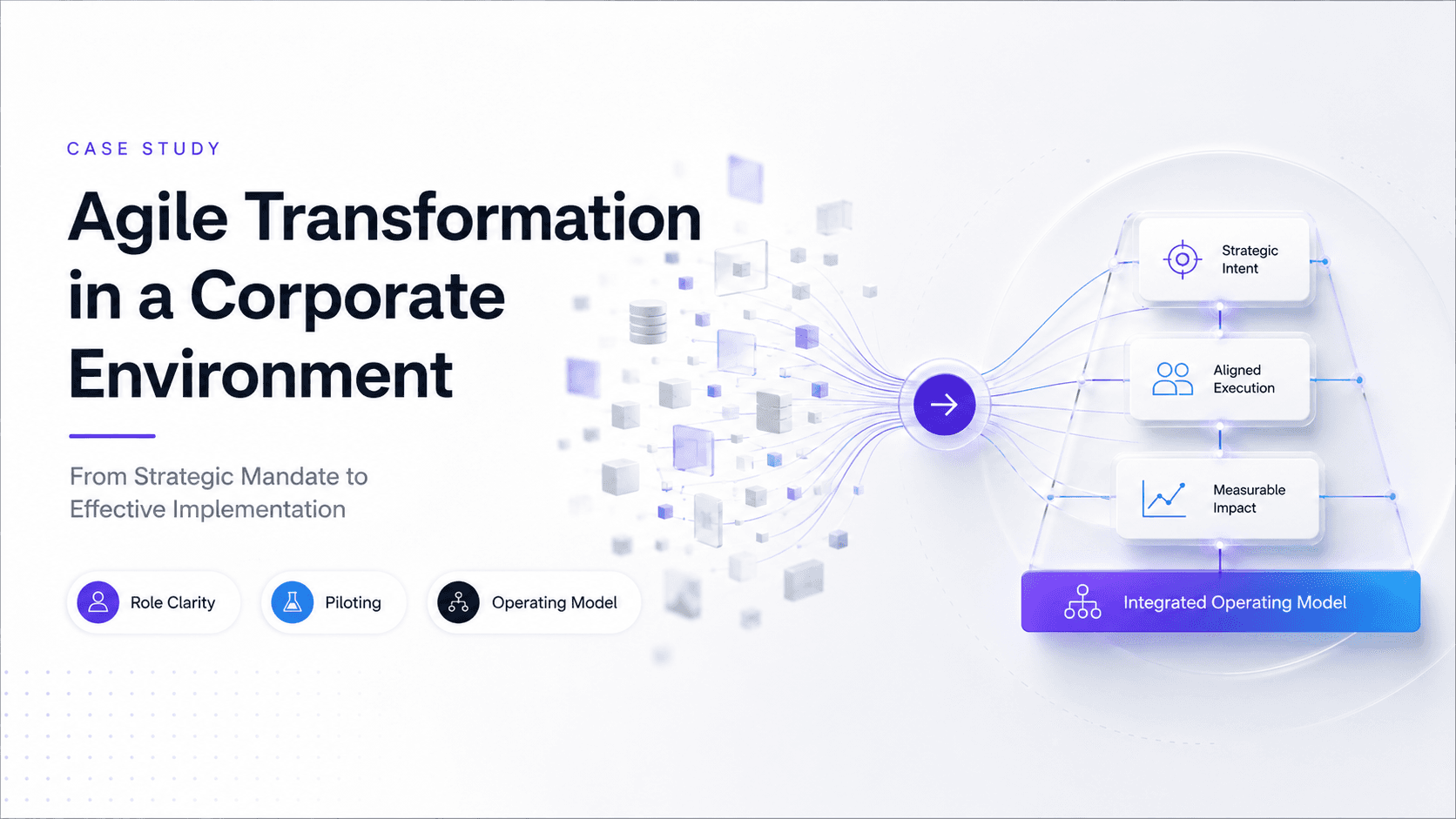
A leading telecommunications company faced a typical but demanding transformation challenge: the international group had defined the transition to agile ways of working as a strategic direction. The goal was to respond faster to market changes, shorten time-to-market, and make collaboration between business, IT, and other organizational areas more effective.
At local level, however, this mandate met the reality of a mature corporate environment: complex legacy IT, established decision paths, functional silos, different levels of agile maturity, and a role landscape that had evolved historically.
The central question was therefore not:
“How do we introduce agile methods?”
It was:
“How do we create a way of working that is actually viable in day-to-day corporate reality and enables better execution?”
Customer Snapshot
Industry: Telecommunications
Transformation focus: Agile transition in a mature corporate structure
Role: Lead Agile Coach / Agile Transformation Lead
Focus areas: Agile transformation, change management, role clarity, operating model design, pilot implementation
Goal: Better strategy execution, clearer responsibilities, shorter decision paths, and scalable agile collaboration
Situation: A Clear Mandate Meets Complex Reality
The strategic direction was clear: the organization needed to become more agile, deliver faster, and respond better to market and customer needs.
At local level, however, it quickly became clear that this transformation could not simply be rolled out according to a central model. Many structures had evolved over time. Decision paths were established, responsibilities were strongly functional, and collaboration between business, IT, product, and project roles involved many interfaces.
The organization was not fundamentally against change. At the same time, it was clear that an agile transformation would only be successful if it connected to the real way of working, the existing governance, and the actual bottlenecks.
Key Insight
Agile transformation rarely fails because people do not understand agile methods. It more often fails because strategy, structure, decision logic, roles, and day-to-day collaboration do not fit together clearly enough.
Challenge: Why a Classic Rollout Would Not Have Worked
A big-bang rollout would have overwhelmed the organization at that point. The maturity levels were too different, the dependencies too strong, and the risk too high that agile roles and events would be introduced only formally without solving the real bottlenecks.
One central challenge was the existing variety of roles. Roles such as Product Manager, Product Owner, Market Manager, Delivery Manager, and IT Project Manager were established in the organization, but they were not consistently understood in day-to-day work.
This created typical areas of tension:
A variety of roles without a shared understanding led to different interpretations of responsibilities.
Overlaps between product, delivery, and project roles delayed decisions or led to repeated alignment loops.
Functional silos made true end-to-end responsibility difficult.
Complex governance meant that decisions took too long or had to be escalated.
Different levels of agile maturity made it clear that teams and leaders needed different forms of support.
Unclear interfaces meant that new ways of working were partially overlaid by old patterns.
The key point was: the transformation did not only need to be planned. It first had to be clarified organizationally.
Without a shared understanding of roles, responsibilities, and decision paths, any agile scaling would have remained unstable.
Key Insight
Role ambiguity is one of the biggest hidden blockers in agile transformations. When product, delivery, project, and market responsibility do not work together clearly, waiting times, duplicated work, and decision bottlenecks emerge, even when teams are formally working in an agile way.
Approach: Transformation as an Iterative Learning System
Instead of changing the entire organization at once, the transformation was deliberately built iteratively.
The approach followed a simple principle:
Start where impact can become visible — and build a scalable foundation for the future in parallel.
The implementation consisted of six connected building blocks:
Systemic analysis of the current way of working
Initial role definition to clarify the current state
Targeted pilot implementation instead of broad rollout
Coaching in the flow of work
Target Operating Model as structural foundation
Agile Employee Journey for orientation and involvement
1. Systemic Analysis of the Current Way of Working
At the beginning, the actual way of working was analyzed systematically. The focus was not on evaluating individual teams or people. The goal was to make the structural causes of delay, friction, and limited effectiveness visible.
The analysis included:
Decision paths and governance routines
Handovers between areas
Waiting times in the flow of work
Unclear roles and responsibilities
Prioritization mechanisms
Interfaces between business, IT, and product responsibility
Dependencies between teams, line organization, and projects
The results were prepared in a fact-based and solution-oriented way. This created a shared understanding of where the biggest levers for change were.
The focus was not agility as an end in itself. The focus was better execution.
Key Insight
A good transformation does not start with the question:
“Which framework should we use?”
It starts with the question:
“Which structures currently prevent effective execution?”
2. Initial Role Definition to Clarify the Current State
Based on the systemic analysis, an initial role definition was carried out. The goal was to make the existing role landscape transparent and create a shared understanding of responsibilities, decision rights, and interfaces.
The organization had a variety of product, market, delivery, and project-related roles. These included, among others:
Product Manager
Product Owner
Market Manager
Delivery Manager
IT Project Manager
Additional business and technical interface roles
These roles were not wrong in themselves. The challenge was that they were understood differently in day-to-day work and partially overlapped.
As a result, it was not always clear who was responsible for prioritization, business decisions, implementation, stakeholder alignment, or delivery responsibility.
The initial role definition helped make the actual current state visible and created a reliable foundation for the further transformation.
The work focused on four guiding questions:
Which roles exist today?
The goal was to create transparency about the current role landscape.
Which responsibility is actually lived?
This made the difference between formal and real roles visible.
Where do responsibilities overlap?
This helped identify friction, duplicated work, and decision bottlenecks.
Which role logic does the target organization need?
This question created the basis for pilot implementation and the operating model.
This clarification was an important step between analysis and piloting. It prevented agile terms from simply being placed on top of existing structures without clarifying the underlying responsibilities.
At the same time, it became visible which role conflicts could be addressed in the short term through coaching and which needed to be solved structurally in the Target Operating Model.
3. Targeted Pilot Implementation Instead of Broad Rollout
Since a large-scale transformation was not realistic at that point, the focus shifted to selected pilot areas. These pilots served as protected learning spaces where new ways of working could be tested under real conditions.
In the pilot areas, concrete improvements were built into day-to-day work:
Clearer roles and responsibilities
Structured backlogs
Transparent visualization of work
Regular planning and prioritization routines
Reviews to jointly assess progress
Retrospectives for continuous improvement
Stronger end-to-end responsibility for outcomes
The pilots had a dual function: they improved collaboration in the selected areas and provided practical learnings for later scaling.
This meant that change was not created through abstract communication, but through concrete experience.
Key Insight
In complex organizations, trust does not emerge through concepts. It emerges through tangible examples that show: it works under our conditions.
4. Coaching in the Flow of Work
Trainings and foundational formats were important, but not sufficient. The real change happened where new ways of working met real priorities, dependencies, meetings, conflicts, and decision logic.
That is why teams, Product Owners, Scrum Masters, leaders, and other key roles were supported directly in the flow of work.
The focus included:
Role clarification to define responsibilities in a clear and effective way
Backlog work to structure, prioritize, and steer work
Reviews to make progress visible and enable feedback
Retrospectives to anchor continuous improvement in everyday work
Dependency management to actively shape interfaces between areas
Leadership to enable new decision and steering logic
In this way, agility was not taught as an abstract concept, but translated step by step into sustainable routines.
Teams did not only learn to run agile meetings. They learned to steer their work differently, make dependencies more visible, and prepare decisions more deliberately.
Key Insight
Training creates understanding. Coaching in the flow of work creates behavioral change. Real transformation needs both.
5. Target Operating Model as Structural Foundation
In parallel to the pilots, a Target Operating Model for the future way of working was developed. This target picture described how agile collaboration can work sustainably in a corporate context.
The Operating Model included, among other things:
Roles and responsibilities
Decision and governance logic
Collaboration between business, IT, and product
Portfolio and prioritization mechanisms
Scaling principles for agile teams
Feedback and steering routines
Guardrails for continuous improvement
The advantage of this parallel approach: the organization did not have to be fully redesigned immediately. At the same time, a reliable foundation for future scaling steps was created.
The pilots provided practical learning. The Operating Model translated this learning into a scalable target architecture.
Key Insight
Team coaching without an operating model remains local.
An operating model without practical anchoring remains theory.
Impact is created when both are connected.
6. Agile Employee Journey for Orientation and Involvement
In addition to the work on pilots and the Operating Model, an Agile Employee Journey was developed and facilitated. The goal was to make agility understandable, concrete, and relevant for employees.
Transformation creates uncertainty, especially when new roles, responsibilities, and decision paths emerge. Therefore, it was important not only to change structures, but also to provide orientation.
The Agile Employee Journey helped to:
Create a shared understanding of agility
Reduce uncertainty and resistance
Clarify roles and expectations
Make concrete examples from day-to-day work visible
Actively involve employees
Strengthen internal multipliers for change
This anchored the transformation not only through processes and structures, but also through communication, participation, and shared learning.
Results: Impact Through Visible Change
The iterative approach enabled change despite complex conditions. Instead of legitimizing the transformation through a large rollout promise, trust was built through concrete impact.
The pilot areas showed that agile collaboration can work in a mature corporate environment when it is introduced in a context-sensitive way and closely supported.
Teams gained more transparency over their work. Priorities became clearer. Alignment became more structured. Roles and responsibilities became more tangible. Blockers in the flow of work became visible and actionable.
At the same time, the Target Operating Model created a structural foundation for further development steps.
Impact at a Glance
Role Clarity
Responsibilities, interfaces, and decision logic became more transparent.
Transparency
Work, priorities, and dependencies became more visible.
Collaboration
Alignment between product, delivery, project, and business roles became more structured.
Decision-Making Ability
Responsibilities and decision paths became clearer.
Learning Ability
Retrospectives and feedback cycles were anchored in everyday work.
Scalability
A Target Operating Model created the basis for further development.
Change Readiness
Trust was built through practical experience instead of communication alone.
Result Statement
In selected pilot areas, central blockers in the flow of work were made visible, roles and responsibilities were clarified, prioritization and decision routines were improved, and agile ways of working were anchored sustainably in day-to-day work.
At the same time, a scalable Operating Model was created as a foundation for further transformation steps.
Key Insight
The most important progress was not only that individual teams worked in a more agile way. The key was that the organization started to better recognize and address its own bottlenecks.
Key Learnings
1. Transformation Needs Connection to Reality
A global mandate can provide direction. But it becomes effective only when it is translated into local structures, decision paths, and day-to-day realities.
2. Agility Cannot Be Rolled Out Like a Tool
Agile ways of working do not emerge from frameworks alone. They emerge through role clarity, better decision routines, transparent work, and continuous improvement.
3. Role Clarity Is a Prerequisite for Scaling
Agile scaling does not work if existing roles are simply renamed or overlaid with framework terminology. First, there needs to be clarity about which responsibilities are actually lived today, where overlaps exist, and which decision logic the target organization needs.
4. Pilots Build Trust
Especially in complex organizations, readiness for change does not emerge through persuasion alone, but through concrete experience. Well-supported pilots make impact tangible.
5. Operating Model and Coaching Belong Together
Team coaching without a structural target picture remains local. An Operating Model without practical anchoring remains theory. Sustainable impact is created when both are connected.
6. Good Transformation Is Iterative Itself
A rigid master plan would have created additional friction in this environment. A more effective approach was one that was agile itself: observe, learn, adapt, and scale deliberately.
Conclusion
This case study shows that agile transformation in a corporate environment is not a linear rollout. It is an iterative change process that connects strategy, structure, leadership, and operational collaboration.
The decisive lever was not to force the transformation against the organization, but to connect it to the reality of the organization: through systemic analysis, initial role definition, targeted pilot implementation, coaching in the flow of work, a clear Agile Employee Journey, and a scalable Target Operating Model.